
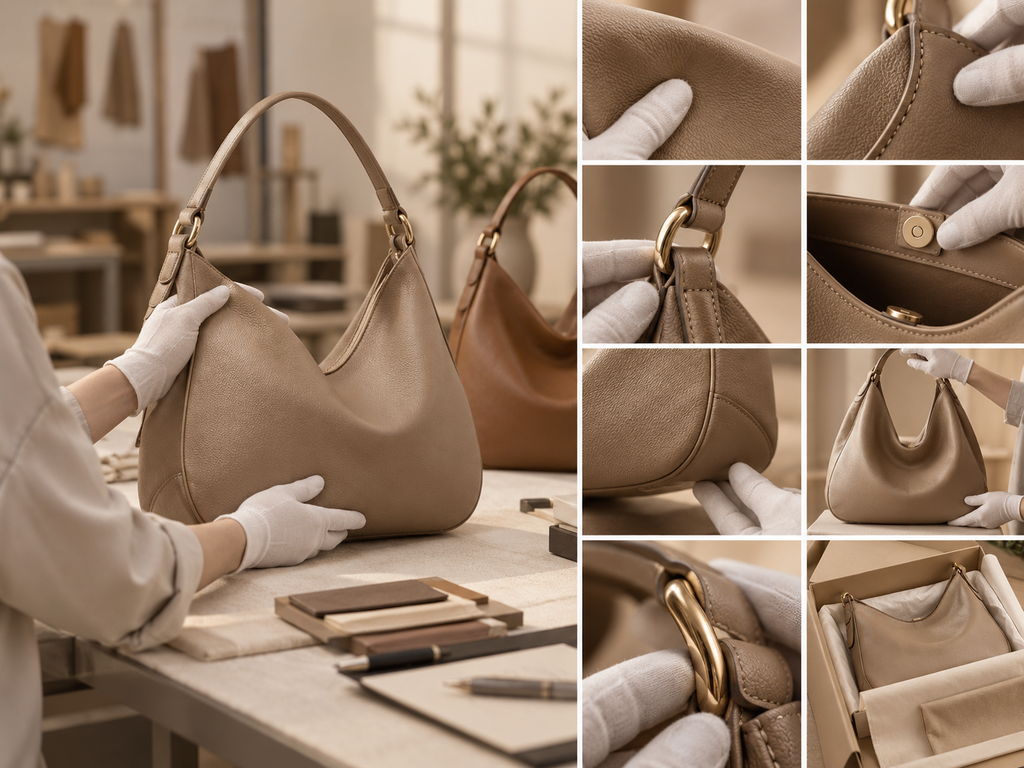
A Practical Pre-Production Sample Inspection Guide for Fashion Brands and Private Label Buyers
Receiving the first physical sample of your custom handbag is an important milestone. After reviewing designs, selecting materials, and discussing manufacturing costs, you can finally see how your product looks and feels in real life.
But a handbag sample should not be approved simply because it looks good in photographs.
Before authorizing bulk production, you need to check whether the sample matches your intended design, measurements, materials, construction, branding, and functional requirements.
An overlooked strap measurement, poorly positioned logo, unstable base, or unsuitable closure can become much more difficult to correct after production begins.
This guide provides a practical handbag sample approval checklist for fashion brands, product developers, private label buyers, and sourcing managers.
It explains what to inspect, how to document problems, when to request revisions, and what should be confirmed before a manufacturer begins producing your order.
1. What Is Handbag Sample Approval?
Handbag sample approval is the process of reviewing a physical prototype or pre-production sample against the agreed product requirements before authorizing bulk manufacturing.
A sample allows the buyer to evaluate the bag’s actual appearance, proportions, materials, construction, and usability.
It also helps the manufacturer identify design changes that may be necessary before production.
Development Sample vs. Pre-Production Sample
These terms are sometimes used differently across manufacturers, but the distinction is useful.
Development Sample
An early physical sample used to evaluate the design, shape, construction, materials, and functionality. It may still require modifications.
Pre-Production Sample (PPS)
A sample intended to represent the final approved product specification before bulk production. Ideally, it incorporates the selected materials, confirmed dimensions, production-intent hardware, approved branding, and construction details.
An early development sample should not automatically be treated as a final production reference.
If the manufacturer uses different sample terminology, clarify which sample version is the actual approval reference for bulk production.
Why Is Sample Approval Important?
The approved sample and written specifications establish a shared reference between the buyer and the manufacturer.
They help both parties agree on what should be produced and which details must remain consistent.
For brands developing custom handbags, this is particularly important when the design includes distinctive shapes, custom components, specific materials, or private label branding.
2. Handbag Sample Approval Checklist: Quick Overview
Review the sample against your approved design and specifications before bulk production.
Important: This checklist is a buyer review aid, not a formal quality certification. Verify all items against agreed specifications, approved materials, tolerances and written approval requirements. Any unresolved critical issue should be addressed before bulk production authorization.
3. Check the Overall Handbag Shape and Proportions
Start by looking at the handbag as a complete product.
Place it on a flat surface and compare it with the approved design drawings, reference images, or specification sheet.
Ask yourself:
- Does the overall silhouette match the intended design?
- Are the height, width, and depth visually balanced?
- Does the opening have the correct shape?
- Are the handles and straps positioned properly?
- Does the bag appear symmetrical where symmetry is required?
- Does the bottom sit as intended?
- Are the gussets and corners correctly constructed?
Soft vs. Structured Handbags
For a structured handbag, inspect whether the shape remains stable as intended and whether the side panels, base, and opening maintain the approved proportions.
For a soft or relaxed handbag, evaluate the natural drape, folds, and flexibility.
A soft leather hobo bag should not necessarily be judged by the same shape-retention criteria as a rigid top-handle handbag.
Approval tip: Compare the sample with the intended silhouette rather than applying a generic definition of good structure.
For buyers developing original handbag shapes, explore Cassitybag’s custom leather handbag manufacturing services.
4. Verify All Critical Dimensions
Dimensional differences can affect both the appearance and usability of a handbag.
Measure the physical sample rather than relying only on the manufacturer’s reported dimensions.
Important measurements may include:
- Bag width
- Bag height
- Bag depth
- Base dimensions
- Handle drop
- Strap width
- Adjustable strap length
- Opening width
- Pocket dimensions
- Gusset depth
Example Measurement Record
| Measurement | Target Specification | Actual Sample | Status |
|---|---|---|---|
| Width | 30 cm | 30.2 cm | Review against tolerance |
| Height | 22 cm | 22.0 cm | Review against tolerance |
| Depth | 10 cm | 10.5 cm | Review against tolerance |
| Handle drop | 15 cm | 14.0 cm | Review against tolerance |
| Strap length | Adjustable | Adjustable | Confirm range |
(All figures above are hypothetical examples. They are not Cassitybag specifications or approved manufacturing tolerances.)
A measurement difference should not automatically be accepted or rejected without considering the agreed tolerance.
For example, a slight dimensional difference may be acceptable for one construction but significant for another.
Confirm the acceptable measurement tolerances before final sample approval.
5. Inspect Materials, Color, and Surface Finish
Material inspection is particularly important for leather and other flexible handbag materials.
The approved material affects not only appearance but also structure, thickness, flexibility, cutting, and stitching.
Material Identity
Confirm that the supplied sample uses the agreed material specification.
For genuine leather, verify the documented type or grade rather than trying to determine the exact leather classification from appearance alone.
For PU or microfiber materials, compare the sample against the approved material reference and technical specifications.
Texture and Feel
Check whether the material has the intended:
- Firmness or softness
- Surface texture
- Thickness
- Flexibility
- Finish
- Visual consistency
A material that looks suitable in a small swatch may behave differently when assembled into a complete bag.
Color Accuracy
Compare the sample against an approved physical material or color reference under appropriate lighting.
Photographs alone may not reproduce color consistently because of lighting, cameras, and screen settings.
Surface Conditions
Review visible material surfaces for unintended marks, excessive inconsistencies, scratches, peeling, or finishing defects.
For natural leather, distinguish between characteristics permitted by the approved material standard and defects that fall outside it.
Approval tip: Record the actual material code or supplier reference, where available, in the final product specification.
6. Evaluate Stitching, Seams, and Edge Finishing
Stitching affects both the appearance and construction of a handbag.
Inspect visible and accessible seams carefully.
Stitching Checklist
Check whether:
- Stitch lines follow the approved positions.
- Visible stitch spacing is reasonably consistent with the specification.
- Seam allowances and panel alignment appear correct.
- There are skipped stitches or broken threads.
- Thread ends are properly finished.
- Reinforced areas follow the approved construction.
- Decorative stitches match the design.
Edge Finishing
Depending on the bag construction, inspect folded edges, painted edges, piping, bindings, and corner finishing.
Look for unintended roughness, gaps, uneven application, or damage.
For painted leather edges, check whether the finish is reasonably even and consistent with the approved appearance.
Do not assume that a visual review establishes long-term durability. Specific durability claims require appropriate testing.
7. Check Handles, Straps, and Attachment Points
Handles and straps are important because they influence carrying comfort, visual proportions, and functional reliability.
A bag may look correct on a table but feel very different when carried.
Handle Review
Check:
- Handle length and drop
- Placement and symmetry
- Grip shape
- Attachment alignment
- Material and construction
- Edge finishing
- Reinforcement where specified
Shoulder and Crossbody Straps
If the bag includes an adjustable or detachable strap, check the adjustment range and attachment method.
Try the strap in its intended carrying configurations.
A shoulder bag should be evaluated for the specified shoulder drop. A crossbody bag should be reviewed at the intended wearing positions.
Attachment Checks
Inspect the visible stitching, hardware, and construction around attachment points.
Do not rely on pulling a handle by hand as proof of an established weight-bearing capacity.
If the bag requires a defined load or durability performance, agree on the test method and acceptance criteria separately.
8. Test Zippers, Closures, and Hardware Function
A closure should work reliably in the approved sample configuration.
Open and close each zipper, magnetic closure, clasp, turn lock, or buckle multiple times during your review.
Zipper Checklist
- Does the zipper open and close smoothly?
- Is the zipper aligned with the opening?
- Is the zipper tape properly installed?
- Does the zipper pull have sufficient clearance?
- Does the opening function without unintended obstruction?
Magnetic and Mechanical Closures
Check whether the closure aligns correctly and functions as intended.
For flaps, review the position, opening movement, and alignment.
Hardware Appearance
Inspect buckles, rings, clasps, chains, feet, and other hardware for:
- Correct finish and color
- Correct size
- Consistent placement
- Visible scratches or damage
- Proper assembly
- Intended movement
If the project specifies metal composition, corrosion resistance, coating durability, or other technical performance, verify the relevant documentation or testing requirements separately.
9. Inspect the Interior, Lining, and Compartments
The interior should be inspected as carefully as the exterior.
Turn the bag opening toward a light source so you can examine the construction.
Check the following:
- Correct lining material and color
- Lining attachment and fit
- Interior seam finishing
- Number and location of pockets
- Pocket dimensions
- Zipper pocket operation
- Dividers and internal compartments
- Interior label placement
- Visible reinforcement or construction details
Check Interior Usability
If the design includes defined functional requirements, test them directly.
For example, if the specification states that a particular object must fit inside a designated compartment, use that object or a dimensionally accurate reference.
Do not infer laptop compatibility, load capacity, or specific storage capacity from the bag’s appearance alone.
The finished interior should reflect the actual product requirements rather than assumptions made during development.
10. Verify Logo Placement and Private Label Branding
Branding errors can be especially problematic for private label collections.
A logo may be correctly produced but positioned incorrectly, or it may have the wrong proportions relative to the bag.
Review:
- Logo artwork and spelling
- Logo size
- Placement measurements
- Orientation
- Application technique
- Color or metal finish
- Embossing or debossing clarity
- Interior label design
- Hangtag and packaging artwork
Embossed and Debossed Logos
Check positioning, visual definition, and consistency with the approved reference.
Metal Logo Plates
Confirm the plate size, finish, attachment, and placement.
Printed or Woven Labels
Review artwork, colors, legibility, position, and attachment.
Approval tip: Document logo position with both a photograph and a measurement from a fixed point on the bag where practical.
This reduces ambiguity when the factory prepares bulk production.
11. Review the Bag in Its Intended Carrying and Usage Conditions
A sample should be evaluated as a functional handbag, not just a static product.
Depending on the design, try:
- Carrying the bag by its top handles
- Wearing it on the shoulder
- Wearing it crossbody
- Opening and closing it while carried
- Adjusting detachable straps
- Accessing interior pockets
- Placing representative intended contents inside
Observe whether the sample behaves as expected.
For example, a soft hobo bag may have a particular drape when partially filled, while a structured handbag may be intended to maintain a more defined silhouette.
These checks provide useful feedback on the design.
They should not be presented as substitutes for formal performance or durability testing where such testing is required.
12. Check Packaging and Presentation Details
Packaging may not change the core handbag construction, but it is part of the product your customer eventually receives.
If branded packaging is included in the project, review the relevant sample or proofs.
Check:
- Dust bag size and material
- Hangtag artwork and attachment
- Care label content
- Protective wrapping
- Carton or individual box dimensions
- Packaging color
- Printed logo accuracy
- Any agreed labeling requirements
Some packaging components may need separate proofs or samples.
If final packaging is not yet available at the handbag sample approval stage, record it as a separate outstanding approval item.
Do not silently treat unreviewed packaging as approved.
13. How to Record Handbag Sample Problems and Revisions
A verbal comment such as “make the handle a little longer” may be difficult to interpret accurately.
Instead, use clear photographs, measurements, and numbered revision notes.
Example Sample Revision Log
| Item | Observed Issue | Required Action | Status |
|---|---|---|---|
| 01 | Handle drop differs from target | Adjust to approved measurement | Revise |
| 02 | Front logo is too low | Reposition using specified reference point | Revise |
| 03 | Zipper catches near corner | Review zipper alignment and construction | Revise |
| 04 | Lining color matches reference | No change required | Pass |
| 05 | Final hardware finish not selected | Confirm finish before approval | Pending |
For each revision, identify what needs to change and what the final approved requirement should be.
Where possible, attach a photograph showing the exact location.
Use Sample Version Numbers
For example:
- Sample V1 — Initial prototype
- Sample V2 — Revised handle and closure
- Sample V3 — Final production-intent sample
Version numbering helps prevent the factory and buyer from referring to different samples.
Maintain a record of which version is approved for bulk production.
When Is Another Sample Necessary?
An updated sample may be appropriate when revisions affect the bag’s structure, dimensions, materials, closure, hardware, or other significant features.
Minor changes may sometimes be resolved through documented approval without producing a completely new sample, depending on the project.
The important requirement is that both parties agree on what has changed and how the final result will be verified.
14. How to Approve a Handbag Sample Before Bulk Production
Once the sample has been reviewed and necessary revisions completed, prepare a final approval record.
The record should identify:
- Approved style number and product name
- Approved sample version
- Confirmed dimensions and tolerances
- Material and color specifications
- Hardware and closure specifications
- Logo, label, and branding details
- Interior construction
- Packaging requirements
- Approved reference photographs
- Any remaining conditions and how they will be resolved
Three Possible Approval Decisions
Approved
The sample meets the agreed requirements and can be used as the production reference, subject to completion of other confirmed order conditions. What’s the order condition? Learn What to Send a Bag Manufacturer for a Quote?
Approved Subject to Documented Conditions
Only use this status when remaining items are precisely defined, responsibility is assigned, and the required verification is agreed before the affected production work proceeds.
Not Approved — Revision Required
The sample contains unresolved issues that require another review before production authorization.
For critical material, structural, or functional issues, requesting an updated sample is generally safer than relying on an informal promise of correction.
Example Approval Statement
“We have reviewed Sample V3 for Style HB-001 against the attached specification revision. The sample is approved as the production reference, subject to the separately documented order and production conditions. No design substitutions or specification changes are authorized without written agreement.”
This is an illustrative approval statement. The actual record should follow the parties’ agreed purchase order and quality procedures.
15. What Happens After Sample Approval?
Sample approval is an important step, but it is not the end of quality control.
The manufacturer still needs to produce the order consistently with the approved sample and confirmed specifications.
A typical process is:
Requirements → Sample → Approval → Bulk Production → Quality Control & Packaging
Confirm Manufacturing Costs Before Bulk Production
Once the handbag sample is approved, it’s important to confirm that the final production quotation reflects the approved design and specifications. Changes made during sampling—such as adjustments to leather materials, hardware, reinforcement, lining, or construction details—may affect the manufacturing cost per unit. Before authorizing bulk production, review the confirmed unit price, order quantity, sample or tooling charges, packaging costs, and applicable shipping terms with your manufacturer.
For a detailed breakdown of the factors that influence production pricing, read our guide to How Much Does Custom Handbag Manufacturing Cost?.
During production, important details may include material consistency, dimensions, stitching, handle attachment, closures, hardware, branding, and overall construction.
Before shipment preparation, finished products should be checked against the agreed quality requirements.
The sample serves as a production reference, but it does not eliminate the need for production controls and final inspection.
For more information about the manufacturing sequence, see Cassitybag’s custom bag ordering process.
Quality Control After Bulk Production
Approving a handbag sample establishes the reference for manufacturing, but it does not guarantee that every finished unit will match the approved specifications. Before shipment, the production batch should be checked for material consistency, dimensions, stitching, handle attachments, closure function, branding, and packaging. Inspection results should be reviewed against the agreed quality requirements before the order is released.
For a practical guide to evaluating finished production goods, read our Handbag Quality Control Checklist Before Shipment.
Final Thoughts: Approve the Sample, Not Just the Design
A handbag can look attractive in a photograph and still contain details that are unsuitable for bulk production.
That is why sample approval should include physical inspection, dimensional verification, functional review, and written confirmation of important product specifications.
For fashion brands and private label buyers, a clearly approved sample helps reduce misunderstandings between design intentions and manufacturing execution.
The goal is not to make the approval process unnecessarily complicated.
It is to ensure that the buyer and manufacturer have a shared, documented understanding of the product that will be made.
Before approving bulk production, confirm what the bag is, how it is constructed, which materials and components it uses, and how the finished order will be evaluated.
Need Help Developing or Revising Your Handbag Sample?
A sample approval checklist helps you identify issues before bulk production, but a successful approval starts with a well-developed prototype.
Cassity supports custom bag sampling, material and construction reviews, prototype revisions, and final sample confirmation for fashion brands.
If you’re preparing a new handbag design or need to refine an existing prototype, explore our Custom Bag Sampling & Prototype Development services to learn how we support the process from initial requirements to sample approval.
Develop and Approve Your Custom Handbag With Cassitybag
Preparing a new handbag collection?
Cassitybag supports custom handbag development, physical sampling, and production based on approved product specifications.
Share your design references, preferred materials, dimensions, estimated quantity, and branding requirements to discuss the development process.
Explore Custom Leather Handbag Manufacturing & Request a Quote
You can also review Cassitybag’s manufacturing process before starting your project.