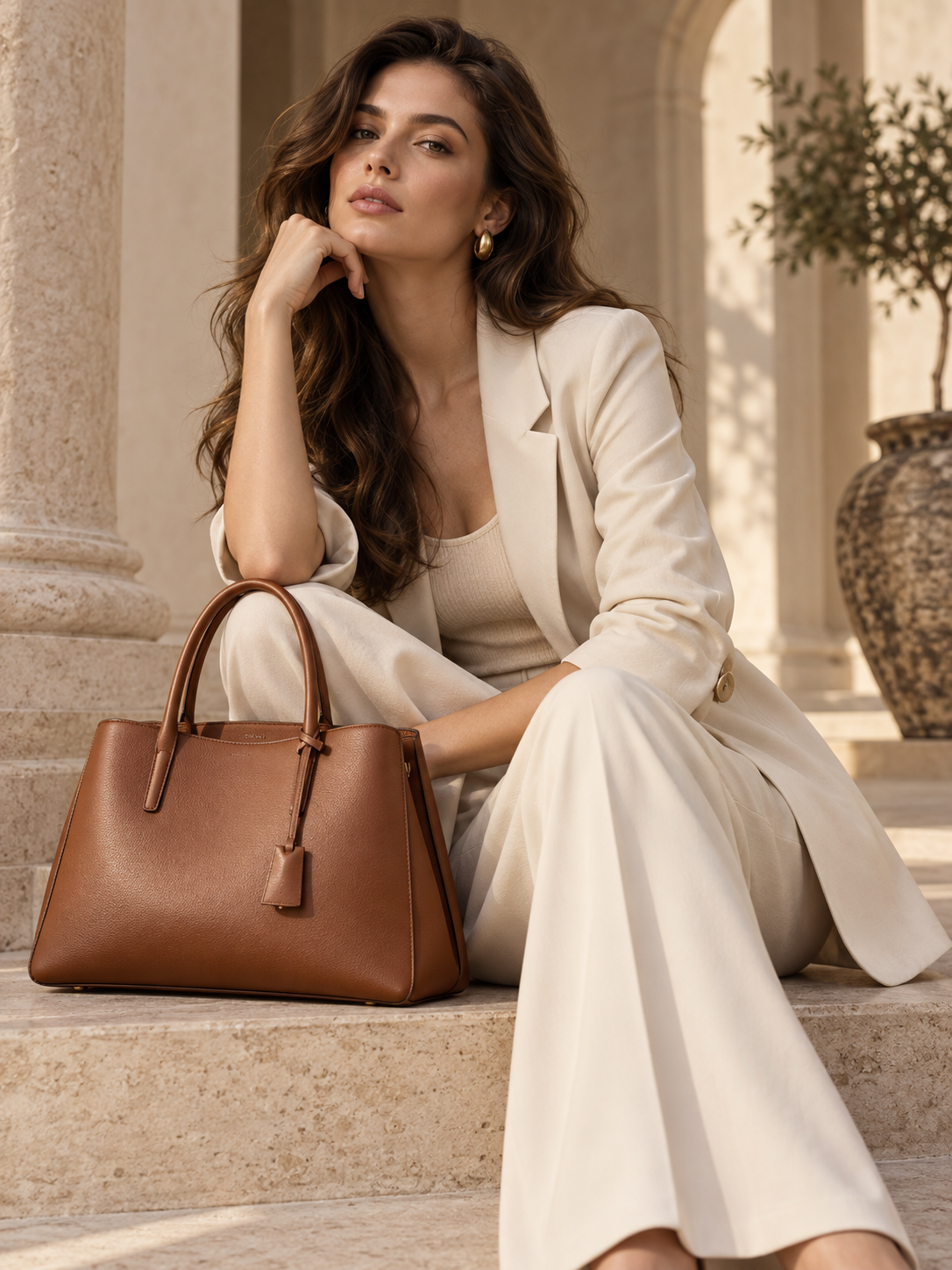
How Minimum Order Quantities Work for Custom Handbags, Totes, Shoulder Bags, and Other Private Label Collections
If you’re launching a handbag brand or developing your first private label bag collection, one of the first questions you’ll probably ask is:
“What is the minimum number of bags I need to order?”
The answer depends on more than the manufacturer.
Material availability, bag construction, color options, custom hardware, branding methods, and production requirements can all affect the minimum order quantity (MOQ).
For emerging brands, MOQ is especially important. Ordering too many bags can tie up capital in inventory, while ordering too few may increase unit costs or make certain customization options impractical.
The goal is to find a production quantity that supports your design, budget, and business stage.
This guide explains how private label bag MOQ works, why minimum quantities vary, and how to plan a first production order without making unnecessary commitments.
1. What Does MOQ Mean in Private Label Bag Manufacturing?
MOQ stands for Minimum Order Quantity.
It is the smallest number of units a manufacturer is prepared to produce under a particular set of specifications and commercial conditions.
For private label bags, MOQ may be calculated by:
- Bag style or design
- Color
- Main material
- Custom hardware
- Logo application
- Packaging components
These minimums are not always interchangeable.
For example, a manufacturer may be able to produce 100 handbags in one design, but that does not necessarily mean it can produce 25 pieces each across four different materials or color combinations.
A project may also satisfy the factory’s assembly MOQ while failing to meet the minimum purchase quantity required by a leather, fabric, or hardware supplier.
This is why it is important to ask what the MOQ applies to, not just what the number is.
What Is Cassitybag’s Minimum Order Quantity?
At Cassitybag, MOQ starts from 100 pieces per style for selected custom bag projects.
Actual minimums vary depending on the bag design, material, color, hardware, logo method, and customization requirements.
The 100-piece starting point is not a guarantee that every design, color combination, or material can be produced at that quantity.
However, we will recommend ready-stock material for you.
For fashion brands planning an initial collection, the best approach is to share the proposed style, specifications, and order breakdown so the production requirements can be reviewed.
You can explore Cassitybag’s private label bag manufacturing services to understand the available product categories and development process.
2. MOQ per Style vs. MOQ per Color: What’s the Difference?
One of the most common misunderstandings in custom bag sourcing is confusing MOQ per style with MOQ per color.
MOQ by Style vs. MOQ by Color
Example: 100 bags of one style, split into Black (50 pcs) and Brown (50 pcs). The two MOQ rules below produce different results.
MOQ per Style
100 pcs
The total reaches 100 pieces for one style. This split may be acceptable if separate color and material minimums also allow it.
MOQ per Color
100 pcs/color
If the manufacturer requires 100 pieces per color, neither color meets its individual minimum, despite the total reaching 100 bags.
Example: Planning 300 Private Label Bags
Consider the following proposed order.
| Style | Color | Quantity |
|---|---|---|
| Leather Tote Bag | Black | 100 |
| Leather Tote Bag | Brown | 50 |
| Shoulder Bag | Black | 100 |
| Shoulder Bag | Burgundy | 50 |
| Total | 300 |
The two styles each total 150 pieces.
However, whether this order is feasible depends on the manufacturer’s style MOQ and color requirements, as well as material and component availability.
If the manufacturer requires a separate minimum for each color, the 50-piece colorways may not qualify.
If color quantities can be combined within a style, the proposed order may be worth evaluating.
(This example illustrates order planning only. It does not represent an approved Cassitybag MOQ arrangement.)
Key takeaway: Never assume that a total order of 300 pieces automatically satisfies every style and color minimum.
3. Why Do Bag Manufacturers Have Minimum Order Quantities?
MOQ is not simply a sales requirement. It often reflects the practical economics of material purchasing and production setup.
A custom bag project involves several activities that may be necessary whether the order contains 100 pieces or 1,000.
Production Preparation
Before manufacturing begins, the factory may need to prepare or confirm patterns, cutting requirements, sewing operations, equipment settings, and quality specifications.
Certain preparation tasks create fixed costs that must be spread across the production run.
Material Supplier Minimums
Leather, PU, microfiber, lining, and other materials may have supplier purchase requirements.
For example, a custom-dyed material may only be available in a production batch larger than the quantity needed for a small handbag order.
The manufacturer may need to purchase more material than the immediate order requires.
Hardware and Component Purchasing
Zippers, buckles, metal logos, clasps, and other components can have separate supplier minimums.
Custom hardware may also involve tooling or development costs.
Production Efficiency
Small production batches can require frequent material changes, component handling, and production adjustments relative to the number of finished units.
As a result, the cost per bag may be higher for smaller orders.
These factors explain why a manufacturer might accept one design at 100 pieces while requiring a larger quantity for another.
4. How Materials Affect Your Private Label Bag MOQ
Material selection can be one of the most significant factors affecting minimum order quantities.
Genuine Leather Bags
Leather bags may require consideration of hide availability, thickness, texture, color consistency, and usable cutting yield.
If a particular leather specification is available from stock, a smaller production run may be easier to evaluate.
A special leather finish, uncommon color, or difficult-to-source specification can introduce additional purchasing constraints.
PU and Microfiber Bags
PU and microfiber materials also have supplier minimums, particularly for custom colors, thicknesses, backing constructions, or surface finishes.
Choosing a synthetic material does not automatically guarantee a lower MOQ than genuine leather.
Standard Materials vs. Custom Materials
For brands planning their first collection, available stock materials may provide more flexibility than developing an exclusive material from scratch.
However, material selection should still be based on the intended appearance, construction, and quality requirements.
Before committing, ask:
- Is the preferred material currently available?
- Does the selected color have a separate material MOQ?
- Can the same material be used across multiple styles?
- Would an alternative specification affect the minimum quantity?
- Does a small production batch create extra material purchasing costs?
A manufacturer can then evaluate which options are appropriate for the proposed design.
5. How Logo and Hardware Customization Affect MOQ
Private label branding is often one of the primary reasons brands approach a custom bag manufacturer.
However, different branding methods have different production requirements.
Logo Embossing and Debossing
Depending on the material and logo design, these methods may require a suitable die and approved application process.
Tooling costs can exist independently of the number of finished bags.
Metal Logo Plates
A custom metal logo may require molds, finishing operations, or a minimum component order.
If the component supplier has a minimum greater than the planned bag quantity, this may affect the project’s economics.
Custom Zipper Pullers, Buckles, and Chains
Specialized hardware can introduce additional purchasing or development requirements.
Where suitable, existing component options may help simplify a smaller first production run.
Labels, Hangtags, and Packaging
Private label requirements may also include woven labels, printed care labels, hangtags, dust bags, and branded boxes.
Each component should be reviewed separately.
For example, an order of 100 bags does not necessarily mean that a custom packaging supplier will accept an order for exactly 100 printed boxes.
Practical tip: Separate essential branding elements from optional custom hardware and packaging. This gives you more options when evaluating the MOQ.
6. Does OEM or ODM Manufacturing Affect MOQ?
OEM and ODM are two common development approaches used in custom bag manufacturing.
OEM generally refers to manufacturing based on a buyer-directed design.
ODM generally starts with a manufacturer-developed design or product concept that may be adapted for the buyer.
These differences can influence the amount of product development required, but neither OEM nor ODM guarantees a particular MOQ.
For example, using an existing handbag design with available materials may reduce some development work.
However, requesting a custom material, exclusive hardware, or major construction changes can create new supplier minimums.
Similarly, an OEM project with a straightforward design and available components may have manageable production requirements.
The important question is whether the selected design and components can be produced efficiently at the proposed quantity.
To understand the distinction in greater detail, read our guide to OEM vs ODM Bag Manufacturing: What’s the Difference?.
7. Is a Lower MOQ Always Better for a Startup Bag Brand?
Not necessarily.
For startup founders and emerging fashion brands, a smaller initial order can reduce the amount of capital committed to inventory.
It may also allow a business to test customer demand before expanding its collection.
However, lower quantities can create trade-offs.
Advantages of a Smaller Initial Order
Lower inventory exposure
A smaller batch limits the quantity of unsold stock if demand is different from expectations.
More flexibility for product development
A brand may be able to gather feedback before committing to larger repeat orders.
Focused first collections
Launching fewer styles and colors can make initial product planning more manageable.
Potential Disadvantages
Higher cost per unit
Fixed development or production expenses may be allocated across fewer bags.
Limited customization options
Certain custom colors, materials, and hardware may not be practical at low quantities.
Reduced purchasing efficiency
Small quantities may not qualify for material or component pricing available at larger volumes.
The best MOQ is not automatically the smallest number a supplier is willing to accept.
It is the order quantity that reasonably balances your product specifications, budget, inventory risk, and expected demand.
8. How MOQ Affects Your Manufacturing Cost per Bag
Order quantity and manufacturing cost are closely connected.
A useful way to understand the relationship is to separate fixed setup costs from variable production costs.
Consider a hypothetical project with:
- A fixed setup cost of US$300
- A variable manufacturing cost of US$25 per bag
The resulting average cost would look like this:
| Order Quantity | Fixed Cost per Bag | Illustrative Average Cost per Bag |
|---|---|---|
| 100 pcs | US$3.00 | US$28.00 |
| 300 pcs | US$1.00 | US$26.00 |
| 500 pcs | US$0.60 | US$25.60 |
| 1,000 pcs | US$0.30 | US$25.30 |
(These figures are mathematical illustrations, not Cassitybag quotations. They assume fixed and variable costs remain unchanged and exclude packaging, shipping, duties, and other possible expenses.)
The example demonstrates how allocating fixed expenses across more units can lower average cost.
In actual projects, material purchasing prices, production rates, hardware requirements, and other cost factors may also change with quantity.
Why You Should Compare More Than Unit Price
A lower unit price can still require a much larger total investment.
For example, ordering 500 handbags ties up more inventory capital than ordering 100, even if the price per handbag is lower.
A growing brand should compare total cash commitment and expected sell-through, not just factory unit pricing.
For a broader discussion, see How Much Does Custom Handbag Manufacturing Cost?
9. How to Plan Your First Private Label Bag Order
A well-planned first production run can make it easier to balance MOQ requirements with collection development.
Step 1: Start With a Focused Product Range
Instead of immediately developing multiple silhouettes, choose a limited number of styles that best represent your brand.
For example, you might begin with one shoulder bag and one tote bag rather than six unrelated designs.
This helps you concentrate development and sourcing work.
Step 2: Decide Which Features Are Essential
Identify the material, silhouette, construction, logo, and hardware elements that define the product.
Then separate them from optional details that may be adjusted if they increase MOQ or cost.
Step 3: Choose Materials With Production Feasibility in Mind
Ask the manufacturer to evaluate whether your preferred materials and colors are practical at the planned quantity.
Consider alternatives only if they meet the intended design and quality requirements.
Step 4: Plan Quantities by Style and Color
Prepare an order breakdown rather than submitting only a total number.
This helps identify whether your proposed collection satisfies the relevant minimums.
Step 5: Request Quantity-Based Quotations
Ask the manufacturer to evaluate feasible quantities and provide corresponding prices.
For example, if a project can be manufactured at 100, 300, or 500 units, comparing these scenarios may help establish your purchasing budget.
These quantities should be treated as quotation scenarios, not assumed available options.
Step 6: Approve the Physical Sample
Before bulk production, review the approved sample for material, dimensions, stitching, structure, hardware, logo, and interior details.
A smaller initial order should still follow a clear sample approval and quality control process.
Step 7: Plan for Repeat Orders
If you expect to reorder a successful design, discuss material availability, component sourcing, and specification consistency.
Repeat-order feasibility should be confirmed rather than assumed.
10. Can You Combine Different Bag Styles to Meet MOQ?
Sometimes manufacturers can discuss combined purchasing or production arrangements, but combining different styles does not automatically satisfy a per-style MOQ.
A tote bag, shoulder bag, and crossbody bag may require different patterns, materials, components, and assembly operations.
Even if their combined quantity is 300 pieces, the manufacturer may need to assess each style separately.
Example: A Three-Style Collection
Suppose a startup brand proposes:
| Bag Style | Planned Quantity |
|---|---|
| Tote Bag | 40 pcs |
| Shoulder Bag | 40 pcs |
| Crossbody Bag | 40 pcs |
| Total | 120 pcs |
Although the order totals 120 pieces, each style has only 40 pieces.
If the applicable minimum is 100 pieces per style, the proposed order would not meet that requirement.
The brand could ask whether an alternative production arrangement exists, but it should not assume that combining the quantities is sufficient.
For Cassitybag, feasibility would need to be reviewed against the design, materials, and customization specifications.
11. What Should You Ask a Low MOQ Bag Manufacturer?
When evaluating manufacturers, do not rely only on an advertised MOQ.
Ask questions that reveal how the minimum quantity is calculated.
1. What is your MOQ per style?
Clarify whether it applies to the finished design as a whole.
2. Is there a separate MOQ per color?
Confirm how the factory handles color combinations within the same style.
3. Do materials have their own minimums?
Ask whether special colors, leather specifications, or custom materials affect the order.
4. Can standard hardware be used?
Determine whether suitable existing components can reduce development or purchasing requirements.
5. Are logo and packaging minimums separate?
Clarify whether branded components introduce additional quantities or costs.
6. How does unit pricing change with quantity?
Request comparable quotations at feasible order levels.
7. What development charges apply?
Confirm sample, pattern, tooling, and revision costs.
8. What happens when I reorder?
Ask about material sourcing, component availability, and repeat-order requirements.
These questions provide a more useful basis for choosing a manufacturer than simply searching for the lowest advertised minimum.
12. What to Send a Manufacturer When Requesting a Low MOQ Quote
A detailed initial inquiry helps the manufacturer evaluate whether a smaller order is practical.
Prepare the following:
| RFQ Information | What to Include |
|---|---|
| Bag style | Tote, shoulder, crossbody, hobo, handbag, etc. |
| Design reference | Sketch, tech pack, reference images, or physical sample |
| Size | Approximate width, height, and depth |
| Main material | Preferred material or alternatives to evaluate |
| Structure | Soft, relaxed, semi-structured, or structured |
| Branding | Logo method and placement |
| Hardware | Preferred components and finishes |
| Color plan | Number of colors and quantity per color |
| Initial order quantity | Proposed pieces per style |
| Packaging | Standard or custom requirements |
| Destination | Delivery country or location |
| Development status | Concept, sampling-ready, or approved design |
If you do not have a completed tech pack, you can still begin with a reference image and a clear description of your requirements.
For a full preparation guide, read What to Send a Bag Manufacturer for a Quote.
13. Private Label Bag Manufacturing With Cassitybag
Cassitybag works with fashion brands, private label businesses, retailers, and growing companies developing custom bag collections.
MOQ From 100 Pieces for Selected Projects
Cassitybag’s stated starting MOQ is 100 pieces per style for selected projects.
Actual requirements depend on the design, material, color, hardware, branding method, and customization scope.
Custom Bag Development
Brands can begin with a tech pack, design drawing, reference image, physical sample, or initial concept.
The development discussion can cover materials, dimensions, construction, hardware, lining, logo application, and packaging.
Sampling Before Bulk Production
A physical sample provides an opportunity to review the proposed bag before bulk manufacturing.
Relevant details include size, shape, material, stitching, handles, straps, closure, hardware, and branding.
Production Based on Approved Specifications
Following sample approval and order confirmation, bulk production is based on the agreed specifications, with quality checks before shipment preparation.
Learn more about Cassitybag’s custom bag manufacturing services or explore the custom leather handbag manufacturing page for handbag-specific development.
Final Thoughts: Choose the Right MOQ for Your Brand
Private label bag MOQ is not simply a number.
It reflects the relationship between product design, material sourcing, manufacturing requirements, customization, and order economics.
For emerging brands, a smaller first order can help manage inventory exposure, but it should still be evaluated against manufacturing feasibility and total project cost.
The best approach is to begin with a focused collection, define your essential design requirements, and ask the manufacturer to explain the minimums that apply to each style, material, and color.
A practical MOQ is one that supports your product specification and your business—not just the lowest advertised quantity.
Planning Your First Private Label Bag Collection?
Start with a design, reference image, or product concept.
Cassitybag supports OEM, ODM, and private label bag development, with an MOQ starting from 100 pieces per style for selected custom projects.
Share your preferred bag style, material, colors, logo requirements, and estimated order quantity so the manufacturing requirements can be reviewed.
Discuss Your Private Label Bag Project & Request a Quote
You can also explore custom leather handbag manufacturing or review the ordering process before preparing your inquiry.